Showing posts with label Our Finite World. Show all posts

Tuesday, 31 May 2016

$50 Oil Doesn’t Work | Our Finite World

$50 Oil Doesn’t Work


$50 per barrel oil is clearly less impossible to live with than $30 per barrel oil, because most businesses cannot make a profit with $30 per barrel oil. But is $50 per barrel oil helpful?
I would argue that it really is not.
When oil was over $100 per barrel, human beings in many countries were getting the benefit of most of that high oil price:
  • Some of the $100 per barrel goes as wages to the employees of the oil company who extracted the oil.
  • Often, the oil company contracts with another company to do part of the oil extraction. Part of the $100 per barrel is paid as wages to employees of the subcontracting companies.
  • An oil company buys many goods, such as steel pipe, which are made by others. Part of the $100 per barrel goes to employees of the companies making the goods that the oil company buys.
  • An oil company pays taxes. These taxes are used to fund many programs, including new roads, schools, and transfer payments to the elderly and unemployed. Again, these funds go to actual people, as wages, or as transfer payments to people who cannot work.
  • An oil company pays dividends to stockholders. Some of the stockholders are individuals; others are pension funds, insurance companies, and other companies. Pension funds use the dividends to make pension payments to individuals. Insurance companies use the dividends to make insurance premiums affordable. One way or another, these dividends act to create benefits for individuals.
  • Interest payments on debt go to bondholders or to the bank making the loan. Pension plans and insurance companies often own the bonds. These interest payments go to pay pension payments of individuals or to help make insurance premiums more affordable.
  • A company may have accumulated profits that are not paid out in dividends and taxes. Typically, they are reinvested in the company, allowing more people to have jobs. In some cases, the value of the stock may rise as well.
When the price falls from $100 per barrel to $50 per barrel, the incomes of many people are adversely affected. This is a huge negative with respect to world economic growth.
If the price of oil drops from $100 per barrel to $50 per barrel, this change adversely affects the income of a large share of people who formerly benefited from the high price. Thus, the drop in oil prices affects the incomes of many of the people listed in the previous section.

Thursday, 12 May 2016

The real oil limits story; what other researchers missed | Our Finite World

The real oil limits story; what other researchers missed


For a long time, a common assumption has been that the world will eventually “run out” of oil and other non-renewable resources. Instead, we seem to be running into surpluses and low prices. What is going on that was missed by M. King Hubbert, Harold Hotelling, and by the popular understanding of supply and demand?
The underlying assumption in these models is that scarcity would appear before the final cut off of consumption. Hubbert looked at the situation from a geologist’s point of view in the 1950s to 1980s, without an understanding of the extent to which geological availability could change with higher price and improved technology. Harold Hotelling’s work came out of the conservationist movement of 1890 to 1920, which was concerned about running out of non-renewable resources. Those using supply and demand models have equivalent concerns–too little fossil fuel supply relative to demand, especially when environmental considerations are included.
Virtually no one realizes that the economy is a self-organized networked system. There are many interconnections within the system. The real situation is that as prices rise, supply tends to rise as well, because new sources of production become available at the higher price. At the same time, demand tends to fall for a variety of reasons:

Monday, 2 May 2016

Debt: The Key Factor Connecting Energy and the Economy | Our Finite World

Debt: The Key Factor Connecting Energy and the Economy


There are many who believe that the use of energy is critical to the growth of the economy. In fact, I am among these people. The thing that is not as apparent is that growth in energy consumption is dependent on the growth of debt. Both energy and debt have characteristics that are close to “magic,” with respect to the growth of the economy. Economic growth can only take place when growing debt (or a very close substitute, such as company stock) is available to enable the use of energy products.
The reason why debt is important is because energy products enable the creation of many kinds of capital goods, and these goods are often bought with debt. Commercial examples would include metal tools, factories, refineries, pipelines, electricity generation plants, electricity transmission lines, schools, hospitals, roads, gold coins, and commercial vehicles. Consumers also benefit because energy products allow the production of houses and apartments, automobiles, busses, and passenger trains. In a sense, the creation of these capital goods is one form of “energy profit” that is obtained from the consumption of energy.
The reason debt is needed is because while energy products can indeed produce a large “energy profit,” this energy profit is spread over many years in the future. In order to actually be able to obtain the benefit of this energy profit in a timeframe where the economy can use it, the financial system needs to bring forward  some or all of the energy profit to an earlier timeframe. It is only when businesses can do this, that they have money to pay workers. This time shifting also allows businesses to earn a financial profit themselves. Governments indirectly benefit as well, because they can then tax the higher wages of workers and businesses, so that  governmental services can be provided, including paved roads and good schools.

Thursday, 17 March 2016

Our economic growth system is reaching limits in a strange way | Our Finite World

Our economic growth system is reaching limits in a strange way


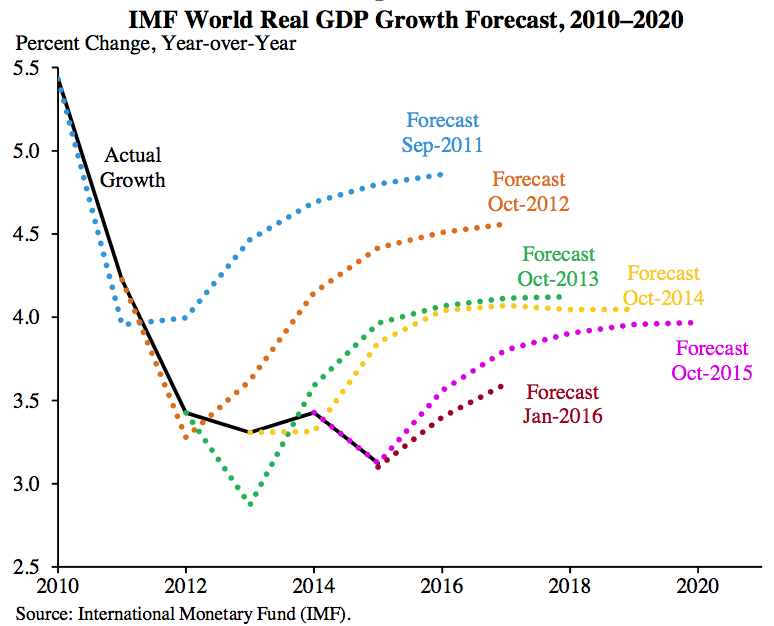
Economic growth never seems to be as high as those making forecasts would like it to be. This is a record of recent forecasts by the International Monetary Fund:
Figure 1. World GDP Forecasts by the International Monetary Fund.
Figure 2 shows world economic growth on  a different basis–a basis that appears to me to be very close to total world GDP, as measured in US dollars, without adjustment for inflation. On this  basis, world GDP (or Gross Planetary Product as the author calls it) does very poorly in 2015, nearly as bad as in 2009.
Figure 2. Gross Planet Product at current prices (trillions of dollars) by Peter A. G. van Bergeijk in Voxeu.
Figure 2. Gross Planet Product at current prices (trillions of dollars) by Peter A. G. van Bergeijk inVoxeu, based on IMF World Economic Outlook Database, October 2015.
The poor 2015 performance in Figure 2 reflects a combination of falling inflation rates, as a result of falling commodity prices, and a rising relativity of the US dollar to other currencies.
Clearly something is wrong, but virtually no one has figured out the problem.

Monday, 8 February 2016

The Physics of Energy and the Economy | Our Finite World

The Physics of Energy and the Economy


I approach the subject of the physics of energy and the economy with some trepidation. An economy seems to be a dissipative system, but what does this really mean? There are not many people who understand dissipative systems, and very few who understand how an economy operates. The combination leads to an awfully lot of false beliefs about the energy needs of an economy.
The primary issue at hand is that, as a dissipative system, every economy has its own energy needs, just as every forest has its own energy needs (in terms of sunlight) and every plant and animal has its own energy needs, in one form or another. A hurricane is another dissipative system. It needs the energy it gets from warm ocean water. If it moves across land, it will soon weaken and die.
There is a fairly narrow range of acceptable energy levels–an animal without enough food weakens and is more likely to be eaten by a predator or to succumb to a disease. A plant without enough sunlight is likely to weaken and die.
In fact, the effects of not having enough energy flows may spread more widely than the individual plant or animal that weakens and dies. If the reason a plant dies is because the plant is part of a forest that over time has grown so dense that the plants in the understory cannot get enough light, then there may be a bigger problem. The dying plant material may accumulate to the point of encouraging forest fires. Such a forest fire may burn a fairly wide area of the forest. Thus, the indirect result may be to put to an end a portion of the forest ecosystem itself.
How should we expect an economy to behave over time? The pattern of energy dissipated over the life cycle of a dissipative system will vary, depending on the particular system. In the examples I gave, the pattern seems to somewhat follow what Ugo Bardi calls a Seneca Cliff.